
The Serengeti is the wide grassland most people picture when they say safari. The useful question is not whether to go, but which part of it matches your dates.
- Region
- Northern Tanzania
- Managed by
- TANAPA
- UNESCO
- World Heritage since 1981
- A usual stay
- Two to four nights
- From Arusha
- A long drive, or a short flight
- Continues into
- The Maasai Mara, Kenya
What the Serengeti is
Serengeti National Park is the core of a much larger grassland ecosystem that runs north into Kenya's Maasai Mara. UNESCO listed the park in 1981. Tanzania National Parks (TANAPA) manages it. The name is usually linked to a Maasai word for the open plain, and the open plain is still the point: long sightlines, big skies, and animals that are not tucked into forest.
People come for two different trips that share a name. One is the resident wildlife around the centre of the park, which is there in every month. The other is the great migration, a moving mass of wildebeest, zebra and gazelle that follows rain and fresh grass. Published estimates put that herd at over a million animals. We treat the number as a description of scale, not as a promise of what your vehicle will count.
The areas, and why the month picks one
The park is too large to 'do' from one camp in a hurry. A lodge in the wrong corner for your dates is the usual way a Serengeti trip disappoints.
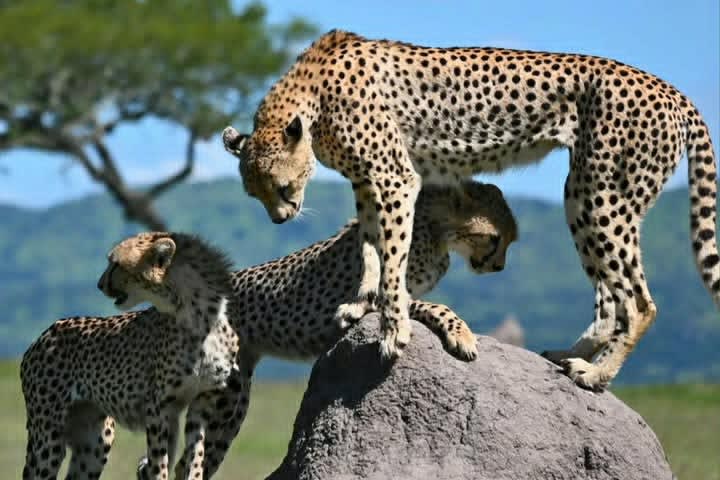
Seronera, the centre. The Seronera river valley is the reliable part. Lions, leopards and cheetahs are seen here through the year because the water and the prey stay. If your dates are awkward for the migration, book the centre and stop chasing a river.
The south and Ndutu. Short-grass plains. From about December to March the herds are often here for the calving, and predators follow. Part of this country sits across the boundary in the Ngorongoro Conservation Area, so a 'southern Serengeti' camp may not be inside the national park gate. Ask which side of the line you are sleeping on. The wildlife does not care. The fees do.
The western corridor. Around the Grumeti, in the middle of the year, the herds are often moving northwest. It is a long way from the south. A trip that tries to see the south and the west in one afternoon is a driving trip, not a wildlife trip.
The north, Kogatende and the Mara River. From about July to October this is where people hope to see a crossing. The river is not a stadium. Herds bunch, hesitate, and sometimes cross at dawn nowhere near the picnic site. Camps up here are remote. Most people fly.
Wildlife, without a checklist
The Serengeti is big-cat country in a way few parks are, because the prey is spread across open ground and you can watch a hunt rather than glimpse a rump in thicket. Lion, leopard and cheetah are all realistic. So are elephant, buffalo, giraffe, hyena and a long list of antelope. Rhino are not the reason to choose this park. If a rhino is the one animal you care about, say so, and we will talk about Ngorongoro or a Mkomazi visit instead of pretending the Serengeti is a rhino park.
Nothing on a game drive is guaranteed. A good day is time out of the car at the right hour, a guide who will sit and wait, and a plan that is not racing to the next park before lunch. Read the Big Five in Tanzania if you want that phrase unpacked. We would rather you watch one leopard for an hour than collect five names.
When to go
There is no closed season. The long rains, roughly March to May, turn roads black and some camps close, and the park is quieter. June to October is dry, busy, and the usual window for the north. December to February is green, with calving in the south, and it is busy again around Christmas and New Year.
The chart is a planning aid. It is not a forecast. For the month-by-month movement of the herds, read the great migration. Tell us your dates and we will say which area we would actually book, including when the honest answer is 'stay in Seronera'.
BestGoodQuieter or wetter
How many days, and how a day works
A Serengeti day is game drives, not a schedule of activities. You leave camp before dawn or after breakfast, picnic from the vehicle, and come back in the late afternoon. Walking is not the normal way to see this park. Night drives are limited to certain concessions.
On a northern-circuit trip the Serengeti is usually the longest stop, with Tarangire, Lake Manyara and the crater fitted around it. A week from Arusha can hold the crater and two or three Serengeti nights. The far north wants more time, or a flight, because the drive from the crater rim to Kogatende is a day in itself.
Flying in from Arusha or the Manyara airstrips saves that day. It costs more than the road and it is worth it when the north is the point, or when you have already spent a week on Kilimanjaro.
Gates, fees and what to ask us
You enter with a licensed guide. Park fees are set by TANAPA, charged per person per day, and they change. We do not print today's tariff on this page. A package either includes the fees or it says it does not. Ask. The same question applies to crater fees on a combined trip, to the flight, and to which meals are in camp.
Naabi Hill is the usual gate from the Ngorongoro side. Other gates serve the west and the north. If someone offers the Serengeti as a day trip from Arusha, it is a day in a car. We would not sell it as a game drive.
Packages that include Serengeti National Park
These are the trips in our list that spend time here. A price is the starting price of that trip. A sample trip is a plan we can run. The camps and the price are confirmed when you ask.
All safaris
Questions people ask
- It is a year-round circuit, not a single week. Calving is usually on the southern short-grass plains from about December to March. The herds are often in the western corridor in the middle of the year, and in the far north, near the Mara River, from about July to October. Crossings are not on a timetable and shift with the rain.
- Two nights is the least we would plan if the Serengeti is the point of the trip. Three or four nights lets you stay in the area that matches the month, instead of driving across the park to tick a box.
- Yes. The herds spend most of the year on the Tanzanian side. The northern river crossings are inside or on the edge of the Serengeti. We do not promise that you will be there on the hour a herd decides to cross.
- No, unless a package says so. Flights leave at dawn from some parts of the park, mostly in the drier months, and they are booked as an extra. Wind can cancel a morning.
- A package shows a starting price only when that trip has one in our list. Sample trips are marked and are a plan to quote, not a price we have invented on this page.
References
The facts on this page were checked against these sources and written in our own words. Gate hours, fees and wildlife numbers change. We link the authority instead of printing a figure that will go stale.
- UNESCO World Heritage Centre, Serengeti National Park
- Tanzania National Parks (TANAPA)
- Serengeti National Park, Wikipedia
- Tanzania Tourist Board
- The great migration, on our site
Last reviewed 2026-10-28.