The northern approach: drier, quieter and gentler.
Rongai is the only main route that climbs from the north. The side of the mountain is drier, the trail is gentler, and fewer people walk it. It is a good choice if you want a calmer first half and do not mind a less varied walk.
Days
6 or 7 on the mountain
Sleeping
Tents
Starts
Rongai Gate, north
Finishes
Marangu Gate
Highest sleep
Kibo, about 4,700 m
Crowds
Quiet until the Marangu trail
What Rongai is
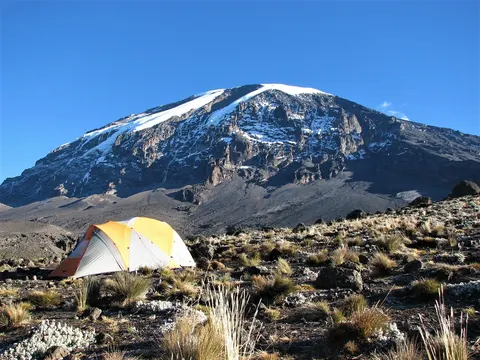
Rongai starts near the Kenyan border, on the north side. It heads up through pine plantation and then forest, crosses open moorland, passes below the jagged Mawenzi peak, and joins the Marangu trail at Kibo Hut for the summit attempt. The descent is by the Marangu route.
Because the north side gets less rain, Rongai is a popular choice in the wet months. It is also much quieter than the southern routes, partly because it is harder to reach and partly because it is less famous.
Rongai route itinerary, day by day
Gate to Simba Camp. A drive of a few hours from Moshi, then an easy walk through pine and forest. Short and gentle. Colobus monkeys are sometimes seen. The camp is at around 2,600 m.
Simba to Second Cave or Kikelewa. Out of the forest and onto open moor, with views north across the Kenyan plains. The trail climbs steadily and the afternoon sun is strong.
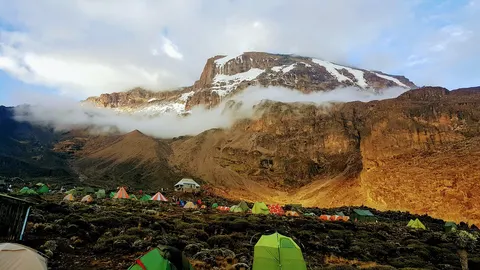
To Mawenzi Tarn. The most dramatic scenery on the route: you walk right beneath the broken ridge of Mawenzi, the second peak. The tarn camp is at about 4,300 m, and the height starts to bite. On the seven-day schedule you get an extra night to settle here.
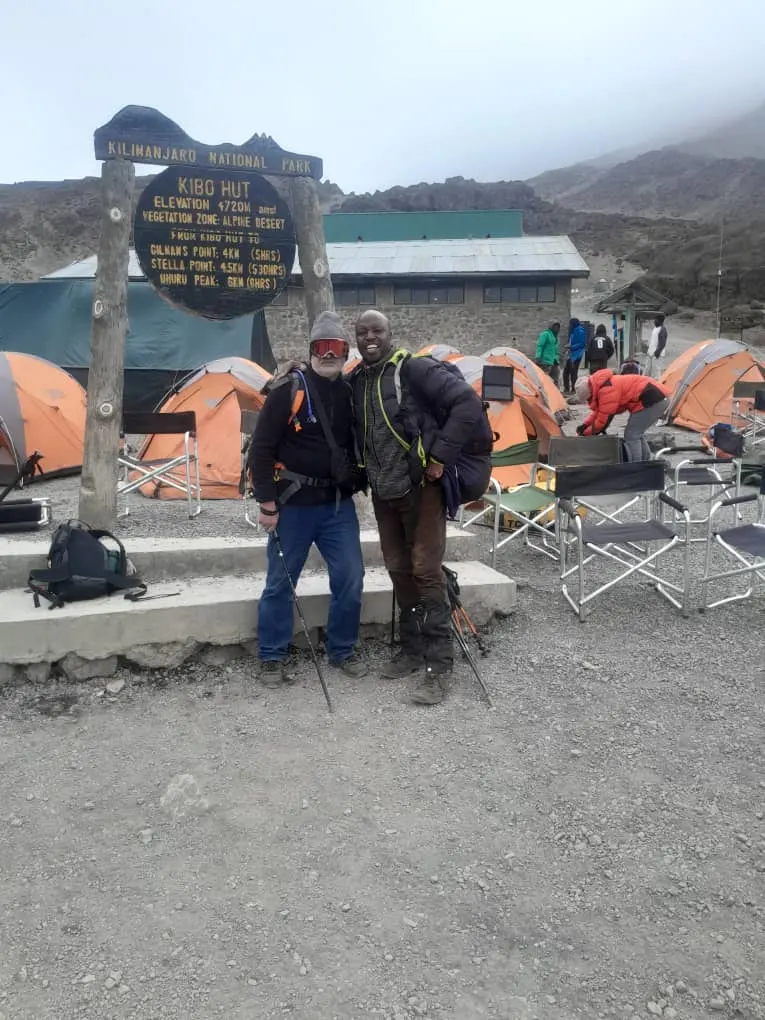
Across the Saddle to Kibo. A bare, windy, treeless crossing to Kibo Hut at around 4,700 m. You eat early, rest if you can and prepare for the night.
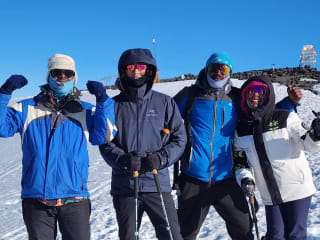
Summit night. Midnight start, same steep scree to the crater rim as on Marangu, with Gillman's Point and then Uhuru Peak. The descent goes down past Kibo and on to Horombo Hut.
Horombo to Marangu Gate. The last day, through moorland and forest.
6-day Rongai route schedule
The standard six-day Rongai schedule, camping on the way up and descending to Horombo Hut.
Day 13 to 4 h
Rongai Gate to Simba Camp
2,600 m · montane rainforest
Day 26 to 7 h
Simba Camp to Kikelewa Camp
3,600 m · montane rainforest to heath and moorland
Day 33 to 4 h
Kikelewa Camp to Mawenzi Tarn
4,330 m · heath and moorland to alpine desert
Day 45 to 6 h
Mawenzi Tarn to Kibo Hut
4,700 m · alpine desert
Day 512 to 15 h
Kibo Hut to Horombo Hut
3,720 m · alpine desert to arctic summit zone to heath and moorland
Day 65 to 6 h
Horombo Hut to Marangu Gate
1,860 m · heath and moorland to montane rainforest
7-day Rongai route schedule
An extra night at Second Cave shortens the longest day and slows the climb.
Day 13 to 4 h
Rongai Gate to Simba Camp
2,600 m · montane rainforest
Day 23 to 4 h
Simba Camp to Second Cave
3,450 m · montane rainforest to heath and moorland
Day 33 to 4 h
Second Cave to Kikelewa Camp
3,600 m · heath and moorland
Day 43 to 4 h
Kikelewa Camp to Mawenzi Tarn
4,330 m · heath and moorland to alpine desert
Day 55 to 6 h
Mawenzi Tarn to Kibo Hut
4,700 m · alpine desert
Day 612 to 15 h
Kibo Hut to Horombo Hut
3,720 m · alpine desert to arctic summit zone to heath and moorland
Day 75 to 6 h
Horombo Hut to Marangu Gate
1,860 m · heath and moorland to montane rainforest
Altitudes and walking times are rounded and vary with season and group. The package you book sets the exact schedule.
The gradient is gentle, and that is a good thing for the legs. It is not a good thing for the lungs: the climb to the high camps is quick, and without the Lava Tower day you have less built-in acclimatisation than on Machame. Seven days makes a real difference.
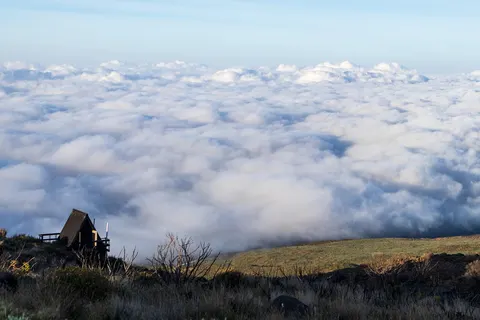
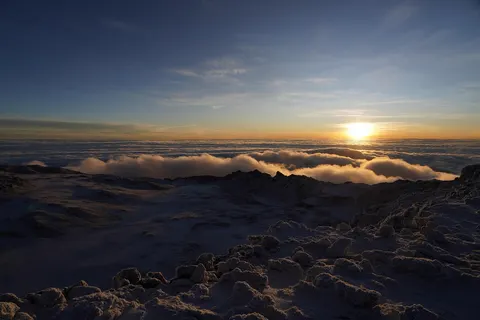
The view is different from the south. There are fewer waterfalls, ravines and glacier views. In exchange you get big skies and the sight of Mawenzi from beneath.
Quick take
Good: drier side, useful in the rains
Good: few people for the first four days
Good: gentle, steady gradient
Hard: less scenic variety than the southern routes
Hard: the summit day is long and the descent joins busy Marangu
Hard: a long drive to the gate
Rongai route price and packages
What you pay depends on the number of days, the group size and the comfort level. The packages below show their own starting price per person from our live price list, and the cost page explains what moves it. Park fees are a large fixed part of any climb, which is why the cheapest quote is not always the best value.
+All meals on the mountain (breakfast, lunch, dinner)
+Experienced lead guide + assistant guide
+Hotel transfers
+Kilimanjaro National Park fees
+Pre-climb briefing & gear check
+Rescue fee / emergency evacuation insurance
+Transfers from Moshi ($820) or Arusha ($870)
Not included
-International flights
-Personal expenses and snacks
-Personal trekking gear
-Tanzania visa ($50 USD)
-Tips for guides and porters
-Travel & medical insurance (required)
Who the Rongai route suits
Climbers who value calm and are happy to give up some scenery. First-timers who want a gentle pace. Anyone climbing in the rainy seasons. People who like the idea of camping but not crowded camps.
Rongai works year round and is the sensible pick for November, April and May compared with the southern routes. In the dry seasons it is excellent too. See best time to climb.
Questions people ask
It is a better bet than the southern routes because the north side is drier, but you can still get rain and cold. Pack proper waterproofs.
The gradient is gentler, so it is easier on the legs. But there is less built-in acclimatisation, so choose seven days if you can.
At Marangu Gate, after the descent down the Marangu trail.
Possibly colobus monkeys in the forest on day one. The trail is not a safari.
Six days works best on Machame, Rongai or a six-day Marangu, if you are fit and have recent altitude experience. If you can find a seventh day, Machame or Lemosho gives your body a much easier ride. See six days or seven.
At the high camps and on summit night it is usually below freezing, and wind makes it feel colder. Layers matter more than one thick coat: a base layer, fleece, insulated jacket, a waterproof shell, warm hat, gloves and a sleeping bag rated well below zero. See packing for Kilimanjaro.
It helps. Around a full moon the trail is visible without a head torch for much of the climb, and it feels less lonely and less cold. It also means more people choose those dates, so book earlier. Check the moon calendar for your month; you can still summit on a dark night with a good head torch.
Tips are a normal and important part of crew income. Guides, cooks and porters are tipped in a pooled way at the end of the climb, in local or US currency, with the group present. Ask your operator for their written tipping guideline before you go, so you can budget; see our tipping guide.
Yes. Choose a policy that explicitly covers trekking to 6,000 m and emergency evacuation. Standard holiday cover often stops at a lower altitude. Read the exclusions before you buy and carry the policy number with you.
Facts on this page were checked against these sources and written up in our own words. Camp heights and times differ between sources by up to about 100 m and an hour; we give rounded figures.